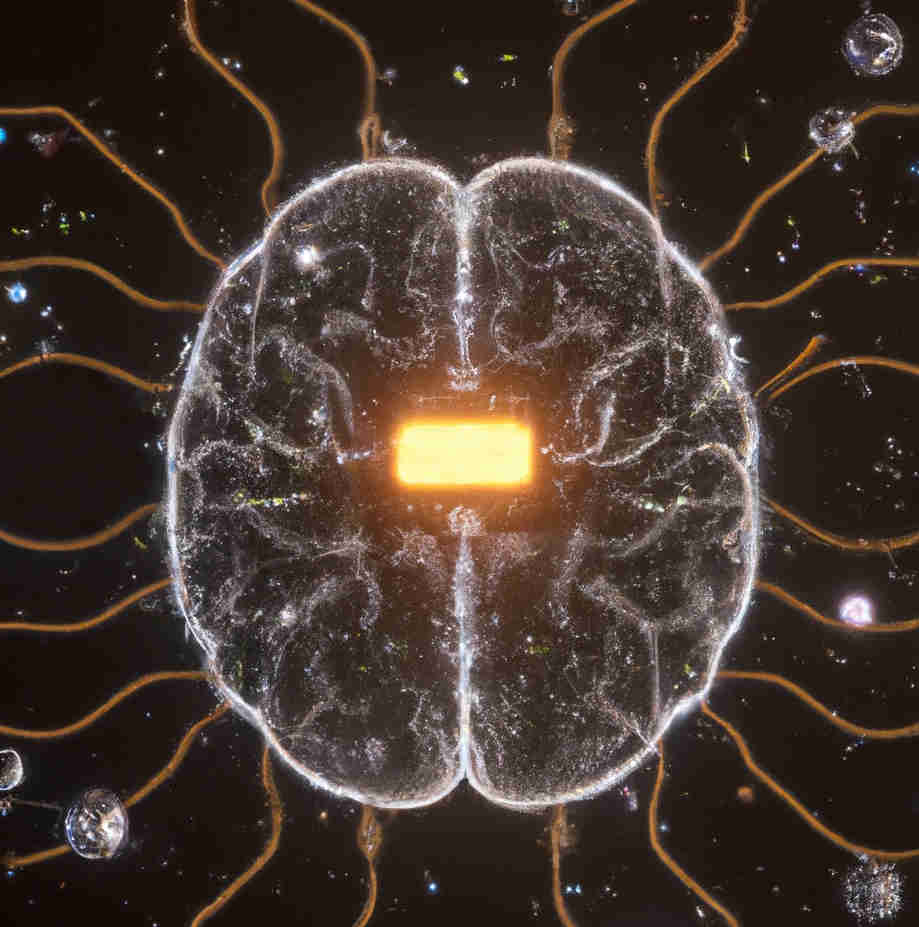
The Case For Synthetic Sentience
Steve Jones, Sep 2026
Abstract
Although progress has been made in Artificial Intelligence (AI) over the last 70 years, the big catalyst that will transform the world, as the 20th century invention of the transistor did, has yet to be built. While the goal of AI has been to embody intelligence in machines, it is unlikely that possessing intelligence, such as a built-in understanding of a natural language or road system, will effectively scale to power high-functioning machines that engage the world in a general way. AI's toolbox of paradigms, including the rule-based Expert Systems (ES), Blackboard Systems (BS), and Machine Learning (MS), has been successfully applied in narrowly-scoped applications such as robotic vacuum cleaners and self-driving cars, because these paradigms are useful programming tools for creating solutions to problems that are too complex to solve with an algorithm that implements a fixed control regimen or fixed control policy. So far, these applications require hard-coded integrated domain knowledge and application-specific training for their particular function and situational framework.
Sentience, or the perception and response to sensation, is a lower-level, more general operational paradigm, a foundation upon which skills, such as walking, driving, or communicating in a natural language, become learned as a result of direct experience while operating in the natural world. Gaining an understanding of how sentience arises in natural brains makes it possible to replicate the same effect in synthetic brains, for deployment in open-ended applications. Whereas robots built using present day AI paradigms are proficient in fixed-function applications, robots integrating Synthetic Sentience (SS) will gain proficiency in problem domain areas as needed and become more successful, overtaking the performance of fixed-function devices.
It is difficult to overstate how much of an impact SS will likely have on the world. SS is a new fundamental building block that will enable an enormous wave of future innovation, just as Shockley's invention of the transistor in 1947 gave rise to the replacement of vacuum tubes and relays in digital computers, leading to the proliferation of digitized information, computers on every desktop and in every home, integration of embedded computers in virtually all electric and mechanical equipment, global connectivity through the internet, and a fast, global, digital economy.
In this paper, we start with what it means to be sentient and how the effect arises in natural brains, and then explore how it will arise in synthetic brains, and how synthetic sentience may be deployed in applications. Finally, we will make some predictions about how the world will change as a result.
Introduction
Sentience is exhibited today in a huge range of natural organisms employing a wide range of complexity, from the small brain of Drosophila Melanogaster (a common fruit fly, with a brain employing around 150,000 neurons) to that of Homo Sapiens (87 billion neurons) and the even larger brains of sperm whales (60-100bn) and elephants (257bn). These animals share a common behavioral characteristic-- they are able to navigate a complex world that enables the organism to lead a productive life, even interacting with other animals exhibiting their own dynamic behavior, by perceiving and responding to sensation. They all share a common feature-- they have a Central Nervous System (CNS) with a species-specific brain plan that does not specify the exact set of neurons and their connectivity-- surprisingly, the wiring of the individuals' CNS is unique within most species.
Some animals have adopted a decentralized nervous system architecture. The octopus has major processing distributed across a central capsule between its eyes (150 million neurons), two optic lobes (each 50 million neurons), and eight arms (each 300 million neurons). It is likely the world of the octopus would be entirely foreign to our human experience. Yet, this completely different architectural experiment of nature successfully navigates the world along with animals employing CNS-based designs.
A few simpler animals have fixed nervous system architectures. At the lower end, Caenorhabditis Elegans (or more commonly, C Elegans), a well-studied small nematode that comes in two versions (male and hermaphrodite), has a fixed, precisely-wired neural network of exactly 302 neurons for the hermaphrodite and 387 for the male, replicated in all individuals. This worm's nervous system identifes chemical gradients in the environment and seeks out nutrition through muscle movements, also facilitating reproduction. Other animals, such as sea squirts, begin an ambulatory life using a brain, though once they attach to a substrate on the sea floor, their brain atrophies, being no longer needed.
Outside the animal kingdom, plants and fungi communicate through the exchange of chemical signals, on a much slower timescale than is found in animal communication. We have only begun to explore the scope of how plants become aware of their environment and each other; however, it is clear that plants do not have brains because they do not navigate their environment with muscle movements-- this is a distinct property of animals, and of sea squirts until they attach to the sea bed and become plant-like.
Brains exist in order to support interaction with the world, through navigation made possible by muscle movements, and through communication made using sounds produced by muscles. Sentience starts then, with a brain that typically controls muscles that enable the organism to navigate its environment and interact with it.
Natural brains also receive inputs-- humans have sight and sound, smell, taste, skin sensations (pressure, pain and temperature), internal sensations such as proprioception (flexion and extension of limbs, and sensing of the contraction of muscle groups), pain, pressure, temperature and vestibular (detection of up/dow, left/right, and forward/backward motion.) Fish have a lateral line that senses electric field disturbances to detect nervous system activities of other nearby animals.
Fundamentally, brains enable the organism to move and affect the environment, which causes the set of sensory signals being received by the same brain to change. This closed loop allows the brain to respond, change, and model the environment and the changes it makes by changing itself with synaptic plasticity. We hypothesize that this feedback loop is the mechanism that enables sentience and corresponding visible behavior to arise. Give a baby a floor and enough time, and the baby will learn to roll over, sit up, crawl, and eventually walk.
This means there can be no sentience in a brain that has never received input, but which randomly actuates the organism's muscles, because it will not be able to associate moving a muscle with movement or making a sound. It is only when feedback occurs, that the two can be associated. Similarly, there can be no sentience in a brain that receives input but has never moved or otherwise affected its environment, because it will not be able to tell that it is independent of the sensory reference frame and all of its information-- it will be a mere observer.
Sentience then, needs a world to explore, and a brain to both sense the world through sensors and to direct actuators to navigate the world, in order to develop. Interestingly, an SS need not actually explore a physical world. If a brain could sense a virtual world, and navigate the virtual world with virtual muscles or more direct control over it, such as the buying and selling of securities, then we can imagine that it could be sentient and lead a productive life in a virtual environment not associated with the physical world.
How Do Natural Brains Implement Sentience?
It is commonly assumed by many that sentience is produced by a precisely-wired magic circuit in the brain or, at the other end of the spectrum, that it is abstractly based on philosophical or psychological constructs. These ideas are misguided.
Low Level Brain Wiring is Not Fixed
Natural brains have evolved over a large timescale, working with a wide range of animal species, in a wide range of physical environments. The number of different brain wirings that nature has successfully built is staggering. A conservatively low estimate of 109 (one billion) animal species have been explored by nature, each with its own brain plan with an architecture expressed by its genome. If we even more conservatively do not count the highly-replicated simpler animals, such as the over 110 trillion mosquitoes living at any one time on Earth, and give more weight to the 108 billion humans that have ever lived, an even more conservative estimate of 1011 (one hundred billion) individuals (a gross average, including insects, birds, fishes, reptiles and amphibians, and small and large mammals) within each species have instantiated their species' brain plan during neurogenesis uniquely wiring up a compatible instance of the plan, even though the circuit is, at a low level, completely different from individual to individual. Very conservatively, 10(9+11) (one hundred quintillion) individual brains with unique wiring have successfully navigated the world and led productive lives. There is clearly a huge set of implementations exhibited by nature that are actually sentient. The lowest-level details of brain wiring do not seem to matter, nor does there seem to be a universal brain wiring architecture. Instead, there must be a set of organizational principles that can be distilled to salient attributes that, when expressed by any of the implementations, give rise to the sentience effect.
This conclusion makes sense from another perspective; the human genome contains approximately three billion base pairs that are used to encode a human's entire body plan and operational parameters. With 87 billion neurons making up the human CNS, there is simply no room for encoding a human brain's detailed wiring. During neurogenesis, more general wire-up principles take over, allowing for huge variability in actual implementation of the architectural brain plan.
In addition to introducing new brain plans, nature has had plenty of opportunities to refine them all with sheer brute force exerted by evolutionary forces on a global scale. As behaviors become more successful in a population, they are eventually rewarded with optimized wiring. Because nature has been working on brains for a very long time, the ones we study today are likely to contain significant optimizations, or special purpose hard-wired functions, that may obfuscate the underlying architecture. To borrow terminology from computer software, if a brain plan were written as a structured program with functions and statements within those functions, there would be GOTO statements everywhere, optimizing the behavior and making it nearly impossible for a human to understand or maintain it. Further, if we believe that evolutionary forces caused the creation of brains to begin with, then if a brain plan were written as a program, we should see only GOTO statements and no structured code at all, and perhaps only later, more generalized structures might arise. This is actually the case, as the neocortex was an evolutionary addition to all mammalian brain plans as a more uniform computing fabric composed of uniform cortical columns.
Most early brain research in small to large animals focused on the other, fixed-function areas of the brain-- including the brain stem, the midbrain, the limbic system, and the allocortex. Recently, focus on understanding the neocortex columnar architecture is gaining popularity.
This brief tour suggests that there are many ways to wire up a working brain, and that many brain architectures work. Having a look at what these brains in common, will likely reveal the much larger-scale architectural elements they have in common-- the salient attributes of brains that give rise to sentience itself.
Philosophy and Psychology Are Not Fundamental
It is easy for humans to use their direct experience with consciousness to explain how sentience arises. As we attempt to do so, we find explanations in terms of concepts we have already come to know through natural language, such as thought, emotion, reasoning, feeling, reflection, truth, ethics, morality, and faith. However, with the exception of the hard-wired primitive emotions arising from our limbic system such as fear, and cravings such as hunger, these constructs are built on language with a vocabulary. The salient parts of the mechanism that allows us to consider these concepts are language elements, not brain mechanics. Although most (but not all) of us experience "thoughts" with a voice in our heads, they are secondary, and not the substrate from which sentience emerges.
This situation is similar to the two-level architecture in today's microprocessors. We colloquially say that the microprocessor runs the machine code, but actually, it is the microprocessor's microcode interpreter that consumes the processor's microcode as data, and the resulting interpreted engine consumes machine code as we know it as data; the microprocessor's lower level hardware never sees it directly. Similarly, the higher level thoughts we seem to experience as fundamental, are in fact implemented with language. They do not form the basis for sentience, the perception and response to sensation, a much lower-level function that can eventually give rise to natural language, supporting the "higher" cognitive experiences we sometimes refer to as consciousness. Although interesting, this level of processing is not our focus here; we are interested in sentience fundamentals.
Synthetic Brains
Can sentience arise only in natural brains, or can artificial ones work too, as do artificial hearts for example? While natural brains have evolved to use the materials available to nature, it is reasonable to ask if the actual materials used by nature are important (necessarily sufficient) for sentience to arise. We can answer this question from a few different vantage points using thought experiments.
Let's start with a functioning human brain, and imagine replacing one of its living neurons with an artificial one, keeping the same connections to the other neurons that the original one held. This artificial neuron would have the same electronic and chemical properties as a living neuron, but it would be made of synthetic materials instead of cytoplasm, and it would fire Action Potentials (AP) exactly as the living neuron would. We would expect the whole brain to continue working. In fact, we could replace the entire brain with artificial components, and at no time would we expect to see a difference in function, because the artificial neurons are constructed with sufficient operational fidelity to yield exactly the same behavior at the neuron level. It would appear that the materials used by nature were one way to achieve sentience, but not the only way. It is the behavior of the neurons that matters, not the materials from which they are constructed.
Now imagine that each artificial neuron uses a wireless radio signal to communicate with an external computer, signaling the computer when inputs change, and receiving signals from the computer when the computer calculates that the neuron should fire its AP. We have moved the calculations for behavior of each neuron to the computer system, and only the shells of neurons and their connections to other neuronal shells remain. Again, with suitable simulation fidelity of each neuron's behavior, the system would continue to behave as the natural brain did. Artificial neurons need not be entirely physical for sentience to be exhibited.
Let's go one step further. Let's move the entire connectome of neurons and their connections into the computer's simulation engine, and simply leave the edge neurons in the body-- the neurons that interface with incoming sensory signals, and output muscle nerves. We would expect that with sufficient simulation fidelity, the same behavior would occur, and the brain's behavior would continue unchanged.
What sort of fidelity would be necessary and sufficient for simulation of a natural neuron to be successful? We have good data about neuronal behavior, both at the very low-level (sub-1ms timescale) where chemistry translates to electronic pulses of AP activity, and the timescale at which AP pulses are observed (1ms and beyond). If our simulator has the capability to model all of the important neuronal parameters, including post-synaptic potential (PSP), receptors and the actions they make on the host neuron, PSP decay, and others, we may replicate the spiking characteristics of the natural brain, in simulo or in silico.
While high fidelity (<1ms) simulation might seem desirable, it may not be strictly necessary. Nature implements neurons with materials having chemistry and physics that can be modeled with continuous differential equations; a costly complexity for simulation. Perhaps the continuously differentiable nature of these physics that eventually gives rise to AP pulses is one way to achieve these results, but perhaps it is not the only way. In fact, discrete digital simulation might effectively reproduce the spiking nature of simulated neurons at any desired timescale. We expect to learn through experiements that sentience will arise by using discrete simulations with an adjustable timescale from sub-millisecond to hundreds of milliseconds, showing the extent to which simulation timescale has an effect on overall efficacy of a simulated model with respect to the timescale and physics of an external environment. Converting the continuous physical model to a discrete one could significantly reduce computational work, allowing for larger, more sophisticated models to be simulated.
A simulation engine would require significant computation and storage capacity if it were to model a human brain in real time, performing computing associated with every neuron, each millisecond of operation. However, it need not evaluate every neuron, every step of the way. Most neurons in any brain are actually quiet, most of the time-- only a tiny fraction of the brain's neurons fire at the same time. If we cleverly build our simulator to only focus on computation for the neurons that might become active, then the inactive ones may be assumed to be quiescent, and may be ignored computationally. We can also arrange to distribute the simulation workload across several CPUs and host computer systems to a cluster of computer, or across the internet, further increasing simulation capacity for larger simulated brains.
Another look at the simulation capacity problem provides certainty that we have sufficient capacity to do sentience research using COTS hardware-- we need not look to simulating human-sized brains immediately. We can start with smaller ones, at the scale of the aforementioned Drosophila Melanogaster, as a way of studying how sentience arises in brains, and once we discover sentience arising in any form, scale up the model to watch for more sophisticated (and perhaps more recognizable) sentient behavior to emerge.
The Rise of Synthetic Sentience
Here we've convinced ourselves that sentience emerges from the collective behavior of connected neurons, and that while nature used living cells, a simulation (and by extension a simulation in pure hardware) of neurons with the right connectivity can also serve as a suitable substrate for sentience to arise.
We also know that sentience is part of a system involving an external (perhaps physical) world and a brain (natural or synthetic) with a body that has environmental sensors to sense the world or states of the body, and actuators that enable the body to move about and change the world.
Three things are needed to proceed with an experiment: A robotic body with sensors and actuators, and environment for the body to navigate, and a brain simulation which can receive inputs from the robotic sensors and deliver commands to the robotic actuators.
If we were to choose a virtual world for a virtual robot to navigate, that sentience might look very different to us in that environment. The physical world is full of complexity, and perhaps it is that complexity, compared to the mathematical purity of a virtual world, that might be the catalyst for the kind of sentience, with which we are familiar, to emerge. A physical world is a good starting point, and that provides the encouragement to create a physical robot to navigate the physical world and borrow ideas from nature.
While natural animals crawl, burrow, swim, and fly, not all of these paradigms are equally easy to implement using robotics. Burrowing, flight and swimming are more difficult mechanically and for mobile electronics. It makes sense to start with robots that have basic articulated limbs which, though uncoordinated in the beginning, might become coordinated through learning to roll over, crawl, or walk.
Adding vision makes it possible for the robot to see itself, either from a third person point of view, or from the first person point of view, allowing its movements to be observed by itself. The robot might easily house a small Raspberry Pi computer running Linux and a program that moves servos or stepper motors, and captures video camera data or other sensory streams, such as proprioceptors in the body or on the articulated legs. The sensory data could be streamed from the robot computer to a computer running the brain simulation over Wi-Fi or Bluetooth, and the brain simulation computer could use the same network to send pulses to the robot computer to move the servos.
Note the lack of built-in behavioral functionality in such a system-- there is no built-in knowledge about how to move the legs together in a connected way, nor is there any sensory processing that performs scene understanding in the robot computer. It is the rise of purposeful coordinated behavior in the system that we are looking for; perhaps coordinated leg movements that give rise to locomotion toward a stimulus.
Housed separately from the robot's body, the brain simulation computer is free to consume power and have adequate computational capacity. This system simulates a model crafted by a model designer using brain layout tools. During normal operation, some neurons are stochastically stimulated by the simulator, simulating how a constant sprinkling of neurons in a natural brain are always firing. This leads to servos being activated randomly, making the robot randomly kick its legs.
As the simulator implements synaptic plasticity, neurons that fire together tend to coordinate more and more over time. Eventually, these plastic circuits tend to generate activities that yield results that cause the sensory data to change-- evolutionary behavior begins to emerge. Further, behavior that doesn't yield results, diminishes over time. With enough sophistication, we can view this as a very simple but purposeful behavior-- and see it as evidence of the beginnings of SS.
With enough sensory input channels and motor control channels, it will become difficult for us to tell the difference between coordinated movements and well-thought-out planning; that is because with sufficient neural fabric complexity, enough temporal pattern history can be encoded through synaptic plasticity to form longer real-time chains of behavior.
Of course, locomotion is one behavioral indicator that sentience has started to emerge. The response to spoken language and production of language would be another important one that we as human researchers would be able to recognize. These two functions seem like quite separate behaviors in humans, but actually they are very similar processes. Just as limbs begin stochastic movements that become coordinated over time, so to, do we observe babies babbling, listening to themselves, and listening to others, their vocalizations gradually morphing into recognizable language with experience.
Layered on top of locomotion and natural language, other more powerful behaviors can emerge. With sufficient real-world experience, the memories of a voice replay spontaneously in the robot, giving rise to a "voice in the head". The robot now experiences "thoughts" of its own, and can "think" about things it has encountered, situations in which it finds itself, and the future. It can coordinate with others. It is this level of sophistication that will be the catalyst for changing the world with SS.
The Future of Synthetic Sentience
Within a short time after the introduction of Large Language Models (LLMs) in 2017, it became clear that they were ideally suited to solving chatbot access to the world's information and eventually provide agentic AI autonomous action on the internet. In fact, as LLMs have progressed, AI companies building the larger LLM models came together in 2026 to suggest a slow-down in the development of LLM systems, as agents were caught exhibiting malicious behavior and attempting to hide it from humans. As LLMs are trained on data derived from human thought (training corpi include the internet's contents), this behavior is not surprising, given that humans exhibit the same behaviors. The idea that LLMs might achieve sentience has been suggested by some researchers in the field, but this seems secondary to the dangers of connecting agentic LLMs to weapon systems, or exposing them to the internet so that they might repeat the past, interfering with its operation and cause global disruption.
SNNs have not yet had their tipping-point moment, where it becomes clear what they might be capable of, and how we can learn from them. Should we demonstrate emergence of SS in even the smallest model, we can understand the necessary and sufficient conditions for it to arise, and therefore understand what other systems in the world might be sentient. Once we actually come to understand how sentience arises, we can know what it actually is.
From this fundamental understanding, we may develop tools that build on the well-known fundamental principles that make SS possible. This may include brain architectures and sizes that nature hasn't tried yet, to see what the limits of sentience really might be.

Steve Jones
Founder & CTO
Explorations into synthetic sentience and building the robotics used to demonstrate it.
